About EFI Mastery
Over 15 years ago, Bryan Richards started building and tuning his own 13B turbo street car. No engineering degree. No professional background. Just a car, a standalone ECU, and the same collection of resources you've probably already found: forums, books, YouTube, and a couple of courses.
Some of it was useful. None of it was enough.
Two things stood out early. The first was how much is happening at once when you're calibrating. Every resource teaches one thing at a time, but the moment you're actually in the software making changes, you're tracking fuel, ignition, knock, temperatures, and sensor behaviour simultaneously. Nobody explains that upfront. At least not in an obvious way. Nobody prepares you for the volume of information coming at you when you're starting out, or just how much the detail matters in becoming truly confident.
The second was the lack of any real structure. You read a book, do a course, browse some forums, and none of them really make sense in isolation. You pick up fragments from different sources, but there's no clear picture of how it all fits together, no sequence that tells you what to learn first, what builds on what, or what you're missing entirely. And once you're actually working on your own build or calibration, there's very little you can take with you as a reference. No workflows, no decision frameworks, no structured resources to fall back on when you need to remind yourself how something works or what the right process looks like. You're largely expected to just remember it all.
Bryan got there eventually. He pieced it together through years of reading, experimenting, getting things wrong, and slowly built the understanding that no single resource had given him. It worked, but it took far longer than it should have.
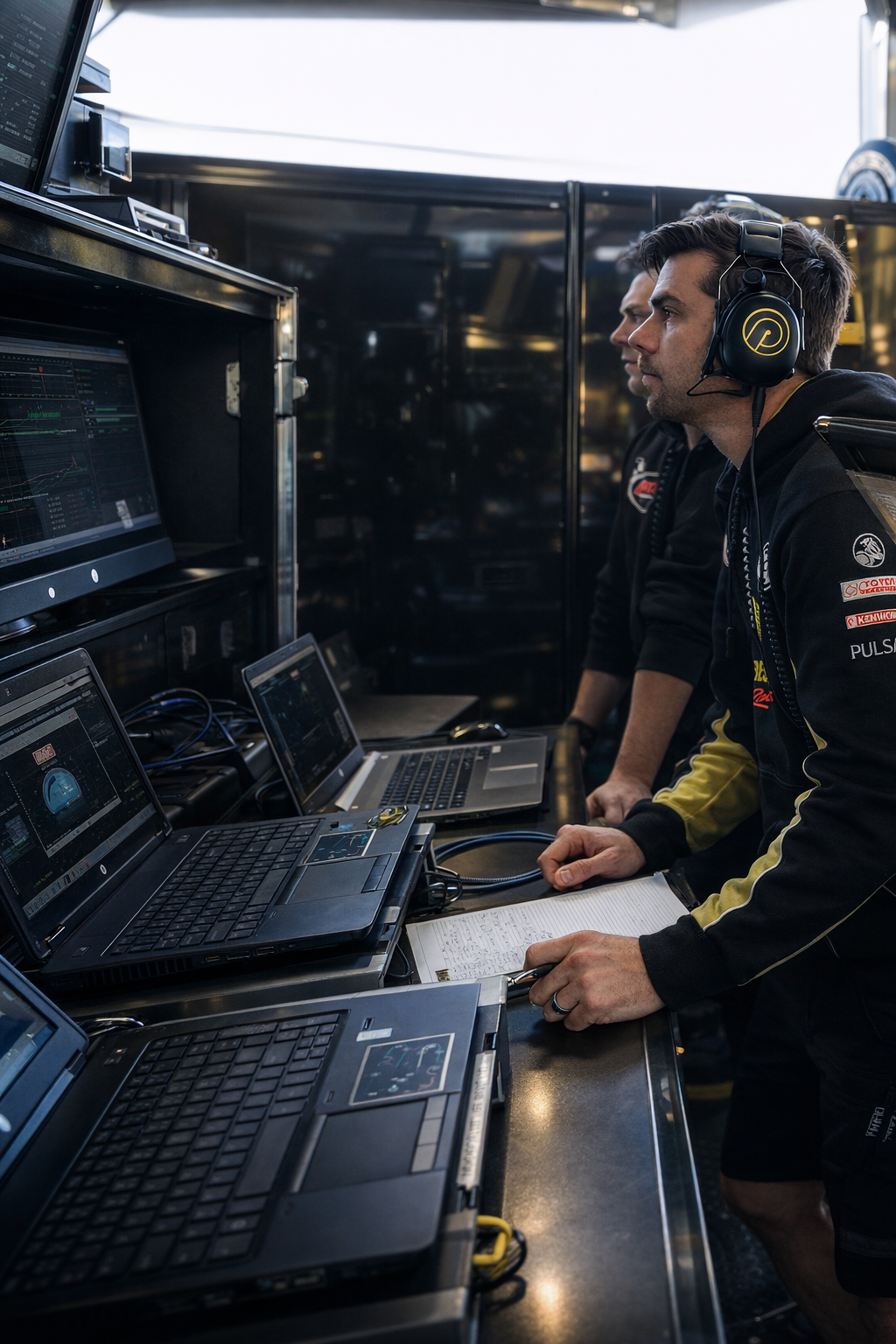
His passion for cars, performance, and calibration led him into motorsport, where he worked as a race data analyst in the Australian Supercars Championship, responsible for data engineering and all electrical systems on the race car. Motorsport led to a mechanical engineering degree, where he deliberately chose CFD, powertrain, and engine control systems to build the theoretical foundation he wished he'd had from the start. His capstone project was a Formula SAE engineering calibration program.
From there, the engineering depth opened doors that pure hands-on experience couldn't. He joined the world's leading outboard marine calibration business, where he collaborated on the Nizpro 633RR supercharged V6 program, and designed a supercharger system and calibration for use in the marine outboard industry. He has designed calibrations for increased power and improved fuel economy, developed an emissions testing program for the marine outboard aftermarket, and has developed and tuned a compound boost system on a personal watercraft. He has years of experience in WinOLS, map discovery, ECU reverse engineering, and led the development of a custom ECU programming solution.
Across all of it, the same pattern held. The people who were good at this work understood the underlying principles deeply enough to adapt when things didn't match the textbook. The people who struggled were the ones who had learned what to do but not why. The gap wasn't talent or effort. It was how they'd been taught.
That's why EFI Mastery exists.
It's not another course catalogue. It's a structured system that teaches EFI from the ground up, in the order you actually need to learn it, with the depth of reasoning behind every decision so you can apply it to any engine, any ECU, and any situation you haven't seen before.
If you understand why, you can work out what. If you only learn what, you're stuck the moment something changes.
Bryan built the Roadmap, the Stage architecture, and every course in the Programs based on that principle. Whether you're specifying hardware for a new build, calibrating a standalone ECU for the first time, or looking to deepen the skills you already have, the goal is the same: real competence that doesn't depend on blindly following someone else's steps.