EFI Master Program

You don't want the short version.
You want all of it.

Know what you're looking for? Skip to the Program

You're not looking for one course to get you through one problem. You want the full picture. How to spec the hardware, how the ECU uses sensor data, what drives combustion and knock behaviour, how to read datalogs properly, how to calibrate a standalone ECU from scratch, and how to control boost delivery. You want to understand the complete system, not just the part you happen to be working on today.

You've probably already started. You've spent hours on forums, watched technical content from multiple providers, maybe even paid for a course. Some of it was useful. But none of it was designed to connect to what came before or what comes after. Every source you've found teaches in isolation, and it's left to you to work out how the pieces fit together and what order to learn them in.

That works up to a point. But the further you push, the more the gaps compound. You understand fuel systems but you're uncertain about the data analysis needed to verify them. You've seen a calibration walkthrough but you couldn't adapt it to a different engine because the reasoning behind each step was never explained. You know boost control exists as a topic but nobody has shown you how it connects to the base calibration underneath it.

You don't need another course on one topic. You need one Program that covers the entire path in sequence, where every Stage builds directly on the last, every decision is taught with the reasoning behind it, and nothing is left for you to piece together on your own.

Why you're stuck

The problem isn't your ambition.
It's that no one built a path for it.

If you want to learn EFI properly, you're currently expected to assemble your own education from scattered sources. A hardware course from one provider. A tuning course from another. YouTube for the gaps in between. And none of it was designed to connect.

The result is predictable. You end up with a patchwork of knowledge at different depths, taught in different orders, with no clear framework tying it together. You know some things deeply and other things barely at all, and you can't always tell which is which until something goes wrong.

Existing courses are built around individual topics, not around a development path. They assume you already know what you need to learn and in what order. For someone who wants complete capability across all systems, that's a fundamental problem. You don't just need content. You need sequence, structure, and a clear line from where you are now to where you want to be.

The EFI Master Program covers every Stage on the EFI Mastery Roadmap. From engine mechanics and hardware selection through combustion theory, data analysis, standalone ECU calibration, and electronic boost control. Every concept is taught in the order you need it, every Stage builds on the last, and every course added to the Roadmap in the future is included at no extra cost.

The way forward

Seven Stages. The complete Roadmap,
now and as it grows.

This is the full EFI Mastery Roadmap. Every Stage, every course, every artifact. Each one builds directly on the last, from foundational engine knowledge through to advanced control systems. No gaps, no missing pieces, no additional cost.

Stage 0
Foundations
You understand how your engine actually works and the engineering principles behind every EFI system.
+

In Stage 0, you will develop the core knowledge of engine mechanics, engineering principles, and platform-specific engine design that underpins the entire Roadmap. You will study how engines work, how pressure, heat transfer, and electrical principles apply to EFI systems, and then go deeper into your specific engine platform through the piston or rotary fork. This is where you build your solid foundation for the Stages that follow.

Courses Included

  • Engine Fundamentals
  • Engineering Principles in EFI Systems
  • Piston Engine Essentials or Rotary Engine Essentials

Key Topics

  • Engine operating principles
  • Pressure, heat transfer, and electrical fundamentals
  • Platform-specific engine architecture

"I know the basics but not the principles" "I have the foundation everything else builds on."

Stage 1
Fuel & Ignition
You can size, select, and evaluate every component in your fuel and ignition system.
+

In Stage 1, you will work through the fuel and ignition sub-systems in detail. For fuel, you will cover how pumps, injectors, regulators, and fuel lines interact in high-demand operating conditions and learn how to size and select components based on your specific power targets. For ignition, you will cover how coils, spark plugs, and coil dwell affect combustion reliability and how to select the right system for your application. By the end of this Stage, you will have a detailed understanding of your hardware, allowing you to specify it correctly, size it accurately, and know what each component is doing when your system is not behaving as expected.

Courses Included

  • EFI Hardware: Fuel System
  • EFI Hardware: Ignition System

Key Topics

  • Injector sizing and fuel system specification
  • Fuel pump, regulator, and line selection
  • Coil, spark plug, and dwell configuration
  • Component interaction under load

"I installed what I was told to install" "I can spec the right hardware for any power target."

Stage 2
ECU Architecture & Control
You understand what your ECU is doing with sensor data, how load strategy works, and how to select the right unit for your build.
+

In Stage 2, you will build a clear picture of what is actually happening inside your ECU. You will start with inputs, learning what each sensor is measuring and how the ECU uses that information to calculate engine load. From there you will work through the three main load calculation strategies, what makes each one suited to a particular application, and where the trade-offs lie. You will then move into control theory, covering the difference between open and closed loop control and what PID control means in practice, not just in theory. By the end of this Stage, you will know how to evaluate and select a standalone ECU for your specific build and how to plan your inputs and outputs before a single wire is connected.

Course Included

  • ECU Functions & Operation

Key Topics

  • Sensor inputs and load calculation
  • Speed-density, alpha-N, and MAF strategies
  • Open loop, closed loop, and PID control
  • ECU selection and I/O planning

"I don't understand what the ECU is doing" "I understand the control system."

Stage 3
Fuel & Combustion
You can set correct lambda targets and ignition timing for any operating condition and manage knock with confidence.
+

In Stage 3, you will develop a solid understanding of the combustion process, fuel properties, and air-fuel ratio targeting that sits at the core of any calibration. You will learn how ignition timing interacts with combustion phasing and why MBT matters. You will also cover how knock occurs and what causes it, so that when you encounter it during calibration you know exactly what the engine is telling you. Three structured decision-making tools are introduced in this Stage: the Lambda Selection Matrix, the Knock Control Matrix, and the Fuel Selection Matrix. You will use all three in every calibration from here on.

Course Included

  • Fuels, Combustion & AFR Essentials

Key Topics

  • Combustion phasing and MBT
  • Lambda targeting by operating condition
  • Knock: causes, detection, and management
  • Fuel properties and selection

"I don't know what numbers to target" "I know why these targets are correct."

Stage 4
Data & Analysis
Your calibration decisions are driven by evidence, not instinct.
+

In Stage 4, you will develop the analytical skills and session discipline that turn raw data into confident calibration decisions. You will learn how to set up sensors correctly, manage logging rates, and apply a consistent methodology across any ECU or logging platform, with worked examples in MoTeC i2, Haltech Datalog Viewer, and MegaLog Viewer HD. The final module puts the process to work through case studies where you analyse real logs and identify the root cause of each issue before the answer is revealed. It is the difference between a calibrator who reads data and one who understands what it is telling them.

Course Included

  • Data Acquisition & Analysis

Key Topics

  • Sensor setup and logging methodology
  • Multi-platform log analysis
  • Root cause diagnostic case studies
  • Session discipline and repeatability

"I'm guessing" "I'm making decisions based on data."

Stage 5
EFI Calibration
You can execute a complete calibration from setup through verification and produce a validated, road-ready tune.
+

In Stage 5, you will work through the complete standalone ECU calibration process using a structured three-phase approach: setup, calibration, and verification. In the setup phase, you will configure your ECU, populate correct starting values, and prepare the engine for its first start. In the calibration phase, you will build your fuel and ignition maps methodically using steady-state and ramp run techniques, calibrate compensation tables across operating conditions, and learn to detect and manage knock with confidence. The course also covers Variable Cam Timing, Drive By Wire, and Flex Fuel calibration, giving you the skills to handle the full range of systems found on modern standalone platforms. In the verification phase, you will validate your calibration through structured road testing and confirm it meets defined completion criteria. You will finish with a fully functional, road-ready tune and a repeatable calibration workflow you can apply to any engine.

Course Included

  • Calibration: Standalone ECU

Key Topics

  • Standalone ECU calibration (NA, supercharged, turbocharged)
  • Flex Fuel calibration
  • Drive By Wire and Variable Cam Timing
  • Compensation tables
  • Structured verification and road testing

"I don't trust myself to tune it" "I have a validated process and a verified result."

Stage 6
Advanced Control
You can calibrate electronic boost control from open loop base map through to consistent, repeatable closed loop delivery.
+

In Stage 6, you will learn how to calibrate electronic boost control, from hardware selection through to closed loop calibration. You will start by building a stable open loop base map, then integrate closed loop control and refine PID gain values against the boost trace until delivery is consistent and repeatable across operating conditions. Worked examples are provided, with principles that apply to any forced induction setup. You will finish with a complete Boost Control Calibration Workflow and the diagnostic framework to distinguish a calibration problem from a hardware constraint.

Course Included

  • Advanced Control: Boost

Key Topics

  • Electronic boost control strategy
  • Open loop base map calibration
  • Closed loop PID tuning
  • Boost control diagnostics

"Boost control feels like a black box" "I can calibrate boost delivery and diagnose problems with confidence."

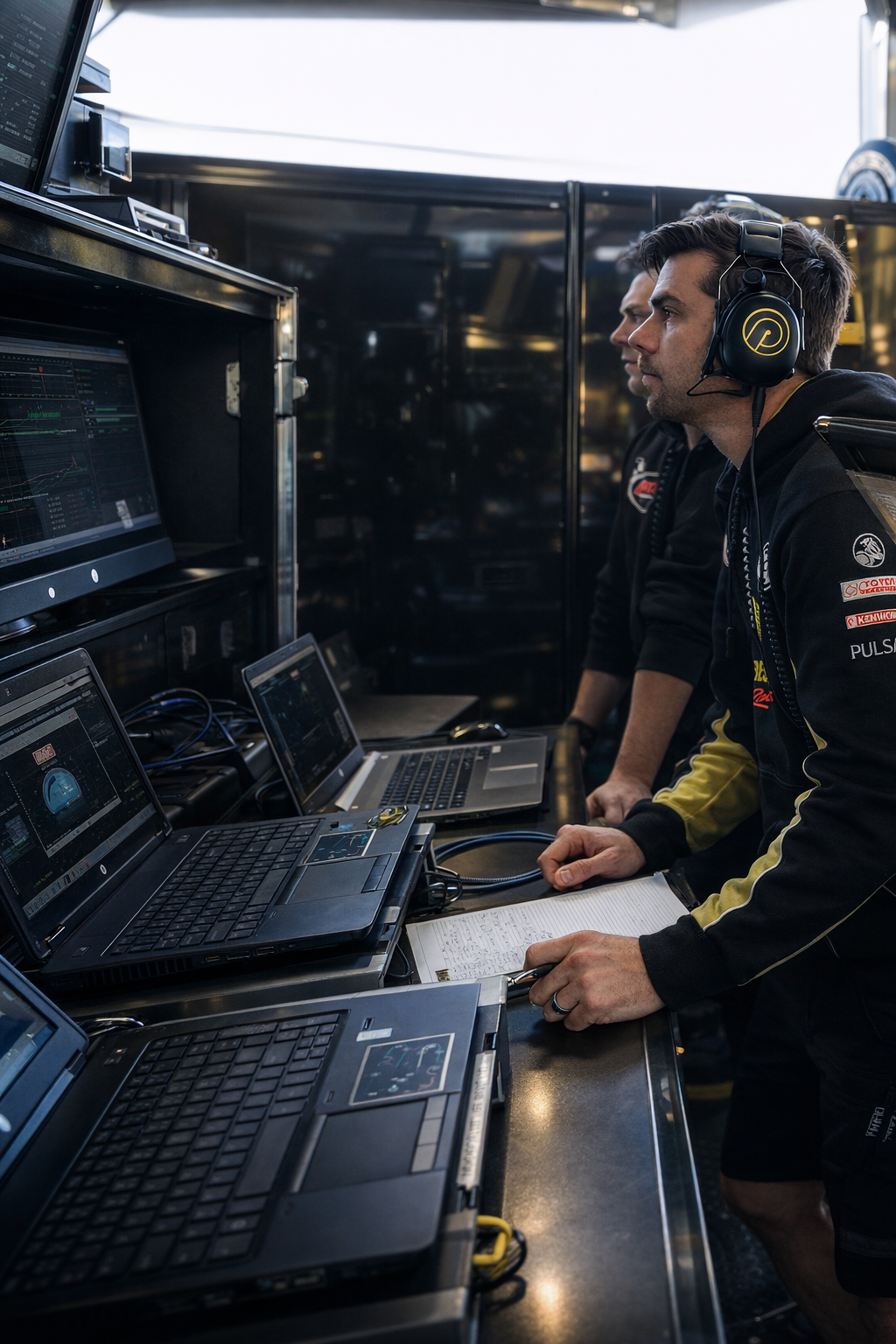
Bryan Richards analysing race data in the Supercars Championship pit garage
Who built this

Bryan Richards spent years learning EFI the hard way, before he had an engineering degree (Honours) or a professional calibration career. He built and tuned his own 13B turbo street car through forums, books, trial and error, and courses that answered some questions but raised even more.

That experience drove everything that followed: a mechanical engineering degree, focused on powertrain and engine controls, race data engineering in the Australian Supercars Championship, marine engine calibration on the supercharged Nizpro 633RR program, and over 15 years experience across Haltech, MoTeC, and Mitsubishi OEM ECU platforms.

He built EFI Mastery as the structured path he wished had existed when he was learning. One system that builds real understanding in the right order, so you don't spend years piecing it together on your own.

What you walk away with

Every Stage. Every skill.
Nothing left out.

Complete hardware specification capability. You can size and select fuel, ignition, and ECU components for any build.

A fully functional, road-ready calibration on any naturally aspirated or forced induction engine, including electronic boost control.

The ability to read datalogs, diagnose issues from evidence, and make calibration decisions with confidence across any ECU platform.

A transferable diagnostic framework that lets you handle problems you haven't seen before, because you understand the principles, not just the steps.

Flex Fuel, Drive By Wire, Variable Cam Timing, and electronic boost control skills that cover the full range of modern standalone platforms.

Lifetime access to every course added to the Roadmap in the future, at no additional cost.

Every future course. Included.

The EFI Master Program includes every course on the EFI Mastery Roadmap today and every course added in the future. As the Roadmap grows, your access grows with it. No upgrade fees, no additional purchases. Founding students who enrol early get the best deal permanently.

Tools you keep

Standalone ECU Calibration Workflow
Boost Control Calibration Workflow
Compensation Table Matrix
Fuel System, Ignition System, and ECU Selection Blueprints
Lambda Selection Matrix, Knock Control Matrix, and Fuel Selection Matrix
Pre-Tuning Mechanical Checklist, Wire Sizing Matrix, logging templates, and Course Summary Workbooks for every course
Start here

EFI Master Program

Stages 0 through 6 · Every current and future course included
Founding Student Price
$1,297 USD
or
3 × $499 USD /month
Regular price after founding spots fill: $1,497 USD

100 founding spots available. Founding students lock this rate permanently.

  • Engine Fundamentals
  • Engineering Principles in EFI Systems
  • Piston or Rotary Engine Essentials
  • EFI Hardware: Fuel System
  • EFI Hardware: Ignition System
  • ECU Functions & Operation
  • Fuels, Combustion & AFR Essentials
  • Data Acquisition & Analysis
  • Calibration: Standalone ECU
  • Advanced Control: Boost
  • All future courses at no extra cost
  • All Stage artifacts and tools
Start the Program. If it's not what you expected, full refund within 30 days.
Is this right for me?
Common questions
What is the difference between EFI Master and buying both other Programs? +
EFI Master includes everything in the Hardware Competence and Calibration Competence Programs, plus Stage 6 (Advanced Control: Boost). Founding students also receive every future course added to the platform at no extra cost.
Do I need to complete all Stages even if I have experience? +
Yes. The Stages are sequential and each one builds on the last. Experienced builders often find the early Stages reframe things they thought they already knew.
What does "all future courses at no extra cost" mean? +
As a founding EFI Master student, any course added to the platform after launch is automatically included in your access. No upgrade fees, no additional purchases. You are locked in permanently at the founding rate with full access.
Is Stage 6 (Boost Control) included at launch? +
Stage 6 covers electronic boost control and is included in the EFI Master Program. Stage 5 covers forced induction calibration at fixed wastegate spring pressure. Stage 6 adds the electronic boost control layer on top of that.

Get notified when doors open.

Join the waitlist for the EFI Master Program. No obligation, no spam. You'll be the first to know when founding spots become available.

No spam. Unsubscribe anytime.

You're on the list.

We'll let you know as soon as founding spots open for the EFI Master Program.